


So, you’ve decided to take up golf – a fantastic choice! Now, you might be wondering, what essential golf clubs will you need to get started? In this beginner’s guide, we’ll walk you through the must-have clubs that will help you confidently navigate the fairways and greens. Whether you’re teeing off or making that crucial putt, having the right clubs in your bag can make all the difference in your game. So, let’s dive in and discover the essential golf clubs every beginner should have in their arsenal.

Driver
The driver is one of the most important clubs in a golfer’s arsenal. Its design and loft are crucial in determining the distance and accuracy of your shots off the tee. The driver typically has the lowest loft among all the clubs in your bag, usually ranging from 8 to 12 degrees. The lower the loft, the lower the ball flight, which is beneficial for maximizing distance.
Regarding distance, the driver is the club that allows you to hit the ball the farthest. Its long shaft and larger clubhead generate significant clubhead speed, which translates into more distance off the tee. The driver’s sizeable clubhead also provides a larger sweet spot, making it more forgiving for off-center hits.
It is essential to have a relaxed yet firm grip to optimize your grip and swing technique with the driver. Start by positioning your hands in a neutral grip position, ensuring that your palms face each other. Maintain a light grip pressure for a more fluid and natural swing. Focus on a smooth takeaway, a full shoulder turn, and an aggressive but controlled downswing to generate maximum power.
Fairway Woods
Fairway Woods are versatile clubs with different numbered options, such as 3-wood, 5-wood, and 7-wood. Each number corresponds to the degree of loft, with a lower number indicating a lower loft. Fairway woods are designed to be hit from the fairway or rough, providing distance and accuracy.
The different numbered fairway woods can be used for various distances. The 3-wood typically has the lowest loft among fairway woods and can be used off the tee or for longer shots from the fairway. The 5-wood offers slightly more loft, making it ideal for shots that require a bit more height and control. The 7-wood, with its higher loft, is perfect for getting the ball airborne quickly and making shots from challenging lies.
Hitting from the fairway or rough with fairway woods requires a slightly different technique than the driver. Place the ball slightly forward in your stance, just inside your front foot. Maintain a smooth and controlled tempo throughout your swing, focusing on making solid contact with the ball. A shallow angle of attack is crucial when using fairway woods to ensure clean ball striking and maximize distance.
Irons
Irons are perhaps the most versatile clubs in a golfer’s bag. They offer control, precision, and the ability to shape shots. Irons come in different types, commonly known as long irons (3-iron to 5-iron), mid-irons (6-iron to 8-iron), and short irons (9-iron and pitching wedge). Each type varies in loft and length, allowing for specific distances and shot trajectories.
Long irons, with their lower lofts and longer shafts, are designed to hit the ball farther, typically used for shots that require distance but less loft—mid-irons balance distance and loft, providing versatility in various on-course situations. Short irons have higher lofts, allowing for better control and accuracy, particularly around the green.
The swing technique is crucial when using irons. Generally, iron shots require a steeper angle of attack than fairway woods or driver shots. Position the ball slightly back in your stance, focusing on making crisp contact with the ball before taking a divot after impact. Maintain a consistent tempo and a descending blow to ensure solid strikes and optimal distance control.
Wedges
Wedges are designed for shots around the green and provide incredible precision and control. There are different types of wedges, including pitching, gap, sand, and lob. Each wedge has specific use cases and varies in loft, bounce, and design.
Pitching wedges are typically included in iron sets and have a higher loft than 9-irons, making them useful for approach shots from the fairway. Gap wedges, also known as utility wedges, fill the gap between pitching and sand wedges. Sand wedges have a higher bounce and are primarily used for shots from greenside bunkers. Finally, lob wedges have the highest loft, allowing for high-trajectory shots with extreme spin.
When using wedges, it’s essential to understand the specific shots they are designed for. Pitching and gap wedges are great for full swings and approach shots, while sand and lob wedges excel in delicate shots around the green. Beginners should prioritize wedges with more forgiving bounce and loft angles to make it easier to execute shots accurately.
Hybrids
Hybrids, also known as rescue clubs or utility clubs, have gained popularity recently due to their versatility and forgiveness. Hybrids are designed to replace long irons, such as the 3-iron or 4-iron, which can be challenging to hit for beginners. They feature a combination of features from fairway woods and irons, making them suitable for various shots and lies.
Hybrids are particularly useful for shots from the rough or fairway when the ball is sitting in a challenging lie. They have a lower center of gravity, allowing the clubhead to glide through the grass more easily, resulting in better contact and increased forgiveness. Hybrids also provide added distance compared to their corresponding long irons.
When hitting hybrid shots, use a similar swing technique to fairway woods. Sweep the ball off the turf rather than taking a divot by positioning the ball slightly forward in your stance. Focus on a smooth and controlled tempo, allowing the club head to do the work. Hybrids are ideal for bridging the gap between fairway woods and irons, providing both distance and accuracy.
Putter
The putter is perhaps the most critical club in your bag regarding precision and scoring. While not necessary for distance shots, the putter allows you to finesse the ball into the hole and save valuable strokes. It is crucial to have a putter that suits your stroke and provides optimal alignment and feel.
Putters come in various types, including blade, mallet, and counterbalanced. Blade putters are more traditional and have a slender profile, allowing for better feedback and control. Mallet putters have a larger, more forgiving clubhead, providing stability and alignment aids. Counterbalanced putters have additional weight in the grip to promote a smoother stroke.
To achieve effective putting, focus on alignment, tempo, and a consistent stroke. Align the putter face square to the target line, with your eyes directly above the ball. Maintain a smooth and rhythmic stroke, keeping your wrists firm and using your shoulders to move the putter—practice speed control by experimenting with different backswing lengths and follow through to find what works best for you.
Golf Balls
Choosing the right golf balls can significantly impact your performance on the course. Golf balls vary in construction and design, with different attributes affecting distance, spin control, and feel.
There are two main types of golf balls: two-piece and multi-layer balls. Two-piece balls have a solid core surrounded by a durable cover, providing excellent distance and durability. They offer less spin, making them ideal for beginners struggling with excessive spin. Multi-layer balls have a softer core and additional layers, allowing for better control and increased spin for more advanced players.
Compression is another crucial factor to consider when choosing golf balls. Compression refers to the density of the core and affects how the ball reacts upon impact. Low compression balls (around 70-80) are typically suitable for slower swing speeds, providing more distance and a better feel. Higher compression balls (above 90) are better suited for faster swing speeds, offering more control and workability.
Durability is also a significant consideration, as golf balls can be easily lost or damaged during a round. Look for balls that are known for their durability to ensure they last longer without sacrificing performance. Additionally, consider the spin control of the ball. Golf balls with more spin can help experienced players shape shots and have better control around the greens.
Golf Club Fitting
Golf club fitting is essential for beginners to ensure they have clubs that match their body type and swing characteristics. Club fitting involves analyzing factors such as club length, lie angle, shaft flex, and grip size to optimize your equipment for maximum performance.
Customization based on body type is crucial to ensure that the clubs are the right length and lie angle for your height and posture. Shorter players may require shorter shafts, while taller players may benefit from longer ones. The lie angle between the clubhead and the shaft can be adjusted to suit your swing path and impact position.
Choosing the right grip size is also important to promote a proper grip and control over the club. Grip size varies, and selecting the correct size based on your hand size can help prevent grip pressure issues and unwanted club movement during the swing.
Overall, golf club fitting assists in optimizing your equipment, enhancing your swing mechanics, and maximizing your potential as a golfer. It is highly recommended, especially for beginners who may not know the impact equipment can have on their game.
Club Bag
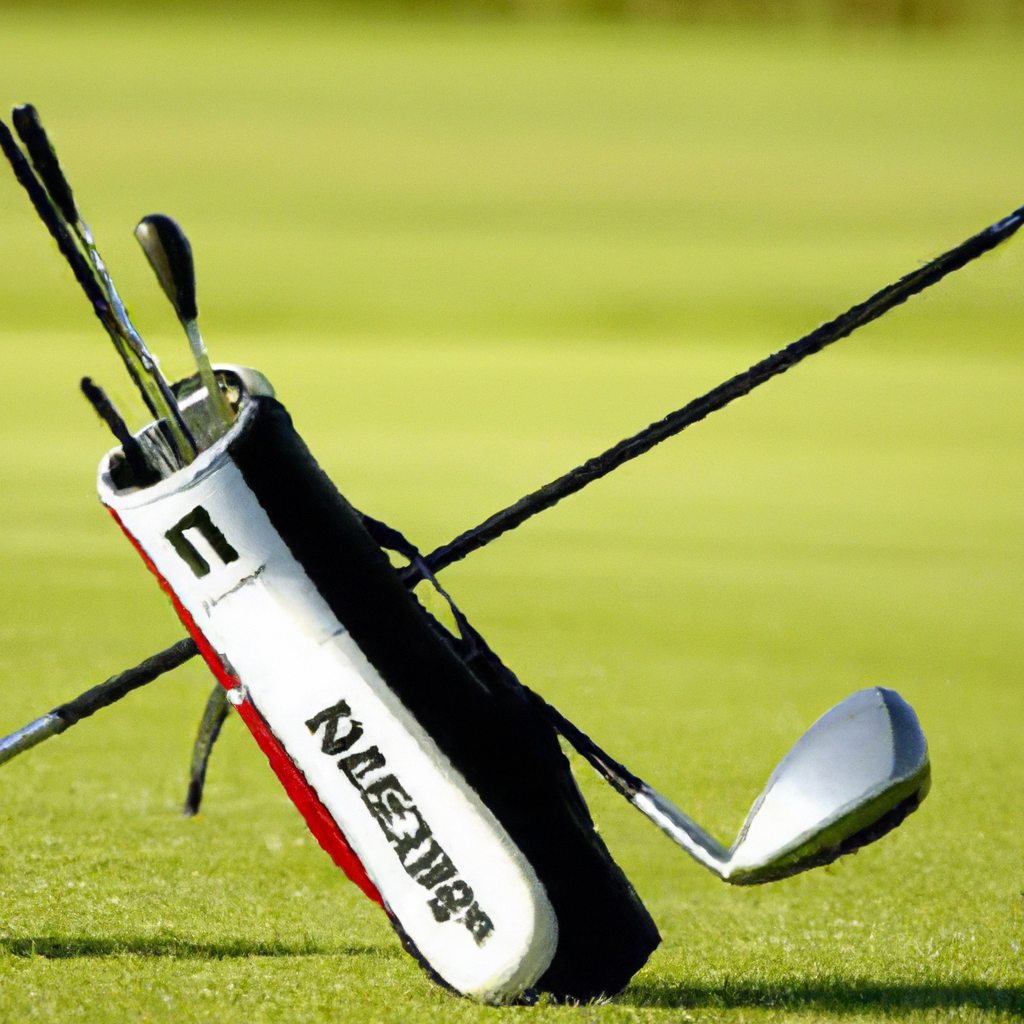
A club bag is an essential accessory for golfers to carry and organize their golf clubs during a round. It is essential to consider several features when choosing a club bag to ensure it meets your specific needs.
One of the primary considerations is club organization. Look for a bag with a divided top or individual club compartments to keep your clubs organized and easily accessible. This prevents clubs from rattling around and potentially getting damaged during transportation.
Additionally, consider the number of pockets the bag has and their sizes. This will determine the storage space available for golf balls, gloves, tees, and other accessories. Look for a bag with enough pockets to accommodate all your essentials without being overly bulky.
Transportation convenience is another factor to consider. Choose a bag that suits your preferred mode of transportation. If you prefer walking, look for a lightweight bag with comfortable shoulder straps or a dual strap system. For those who prefer riding in a golf cart, consider a cart bag that fits securely and has features like strap loops or pockets specifically designed for a cart.
Lastly, choose a bag that reflects your style. Golf bags come in various colors, designs, and materials, allowing you to express individuality while ensuring functionality and convenience.
Accessories
In addition to the essential golf clubs, several accessories can enhance your overall golfing experience.
Golf gloves are an important accessory, providing grip and preventing blisters. Look for gloves that fit snugly but allow for flexibility in your fingers. Choose gloves made from breathable materials to ensure comfort during hot weather.
Alignment aids can help improve your alignment and overall accuracy. These can include alignment rods, laser alignment tools, or simple training aids like alignment sticks. Utilizing alignment aids during practice can help develop a consistent alignment routine, leading to better shots on the course.
Tees and ball markers are essential accessories that are often overlooked. Tees come in different lengths, and choosing the appropriate height for your club can optimize your tee shots. Ball markers mark your ball’s position on the green, allowing you to clean it or move it out of the way of other players. Look for durable tees and ball markers that are easy to spot and will last throughout multiple rounds.
Investing in these accessories can enhance various aspects of your game, from grip and alignment to convenience and overall organization. Integrating them into your golfing routine can positively impact your overall performance and enjoyment of the course.
As a beginner, understanding the essential golf clubs and their roles is crucial for developing a solid foundation in the game. By familiarizing yourself with drivers, fairway woods, irons, wedges, hybrids, putters, and golf balls, you will be better equipped to make informed decisions and improve your overall play. Remember, practice and patience are key; with time, you will develop confidence and proficiency with each club in your bag. Happy golfing!